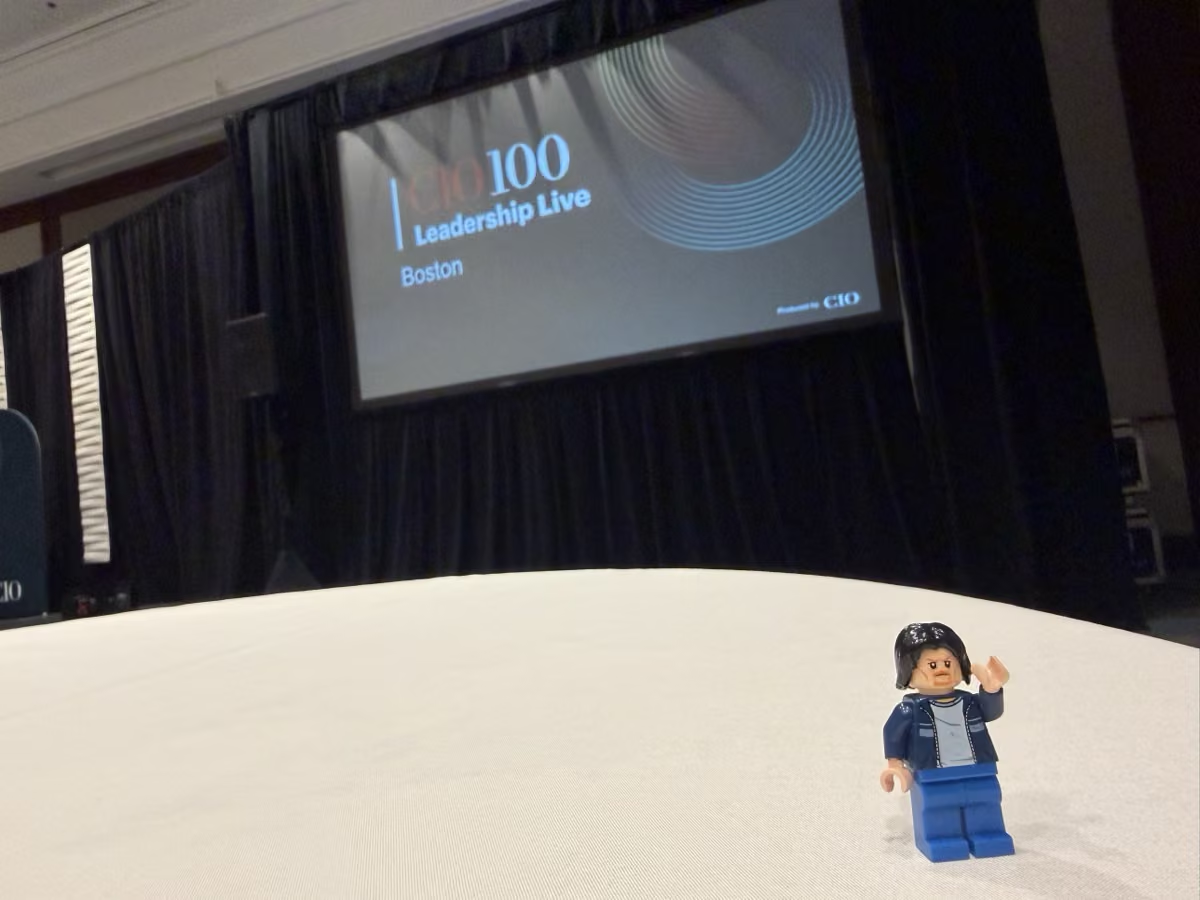
Last Thursday I spent the day at CIO 100 Leadership Live Boston, Foundry’s gathering of CIOs and technology leaders. I wanted to hear how leaders outside the agency and web world think about AI, innovation, and organizational change.
Eight sessions brought speakers from defense, healthcare, real estate, robotics, finance, and venture capital. One theme kept coming back: leading through AI and rapid change is as much a leadership challenge as a technology challenge. Most of the talk covered people, alignment, risk, and knowing where you are trying to go.
At the Where AI Delivers session, Stephen Coyle, Principal, Deals Strategy & Value Creation at PwC, said getting everybody on board is “less about having a road map and the right compass.” That led me to a thought of my own: without a map, we need to be the compass.
Leadership sets the limit
Paul Hlivko, CIO of Optum Financial, put it in one line: the real differentiators are “clarity, culture, and conviction, not code.” Each panelist then named a recent miss, and none was technical.
Paul did not build in enough forcing functions to keep momentum going. Sal Companieh, Chief Information and Digital Officer at Cushman & Wakefield, readied his own team but did not bring his peers along. Mona Bates of BAE Systems assumed her peers did not want to hear about IT and digital.
They did.
The habits they shared were just as human. Mona starts with why and trains the next layer of leaders to carry the message. Paul has run a 30-minute Monday standup with his leaders for 12 years.
He also described “bumper bowling”: set wide boundaries, point at the goal, and let the team run.
Sal treats vulnerability as a leadership tool and watches for small signs of burnout, like calls that once ended with humor turning all business.
Treat AI like a portfolio, then focus it
Several speakers framed AI as a 20- to 30-year curve, and ChatGPT turns four this fall. Everyone is still early.
Paul Hlivko’s advice for this stage is to put the learning cycle ahead of production deployment. He treats AI investments like a venture capital portfolio.
Make 30 to 40 bets, expect many to fail, and let a few big winners pay for the rest. A traditional discounted cash flow model, he argued, is the wrong tool for judging experiments this early.
The PwC team called the free-for-all version “artisanal AI”: give everyone a tool and hope for the best. It produces great demos and very little in production.
Their alternative starts with a business outcome and narrows to five to seven initiatives. It builds for reuse, so the tenth use case costs far less than the first.
Jim Chilton, a five-time CIO now at Southern New Hampshire University, drew a distinction I keep coming back to. Automate the work that doesn’t set you apart, and augment the work that does.
Accounts payable and billing probably aren’t your competitive advantage, but the expertise and judgment of your people might be. He also warned against “spray and pray,” because telling everyone to automate their own jobs can create risks nobody sees until something important disappears.
Some things can’t break, and some can’t wait
Paul Beswick of Marsh McLennan gave me the most useful framework of the day. He splits technology into two groups.
Can’t break covers anything where failure means regulatory trouble, a business stoppage, or harm to clients. Can’t wait covers innovation and change, where a faster and looser approach to risk fits. Trouble starts when the can’t-break mindset spreads into the can’t-wait work and slows everything down.
Sri Sriraman, CTO at Mass General Brigham, made it concrete. Of roughly 2,500 applications, about 300 are core critical paths, and those get the resilience focus.
Two more ideas from that session stuck with me. Oversight built for two-year projects is the wrong tool for releases that ship in a week, so match governance to the pace. And speak in business impact: “The network is 10 years old” gets ignored, while “the hospital can’t run without it” gets funded.
Beswick argued that one of the biggest missed opportunities is pointing AI at your own technology operations first. That means incident response, threat hunting, and the daily work of your own team. It costs little, the team learns by doing, and it builds credibility before you take AI to the rest of the organization.
Reinvention beats transformation
The transformation panel pushed back on the word itself, and Afshean Talasaz, formerly of Colonial Pipeline, prefers “reinvention.” Transformation implies a start, an end, and a visible finish line. Reinvention accepts that parts of an organization change at different speeds all the time.
Picture a set of goals, each guiding a different part of the business. A few lessons from that conversation stuck with me:
- Decide what not to change, and protect the culture and differentiators you would miss most.
- Use benchmarks as data, because a benchmark that becomes the goal stops being useful.
- Finish what you start, because a 1 to 2% misalignment compounds over 12 to 18 months.
- New tools are not change: as Afshean put it, going from a Ford to a Ferrari doesn’t make you a better driver.
Lesley Dickson of VantagePoint described the “spaghetti in the background” that half-finished initiatives leave. The test I took away is simple: if an engineer can’t describe the goal in their own words, alignment has already broken down.
Without a map, we need to be the compass
Nobody on stage claimed to have a step-by-step plan for AI. Boston Dynamics built systems starting in 2020 that it already considers legacy. The playbooks most of us rely on were written for a slower, more predictable world.
Leaders can still offer direction: a clear destination, values and guardrails that don’t move, and the judgment to adjust the route as things change. For me, that plays out in two places.
My team has been working on our playbook for AI-assisted development for more than a year. Alongside it, I say where we are headed, set wide bumpers, and make it safe to try things, fail, share what we learned, and try again.
With our clients, I want to be the steady partner who helps them choose a direction when neither of us has the full route. The nonprofits, health systems, universities, and public institutions we work with don’t need us to pretend to have every answer. They need help working out what can’t break, what can’t wait, what is worth trying, and what should stay as it is.
What I’m taking home
I left with more questions than answers.
For my team:
- Which of our AI experiments deserve real focus, and which should we stop?
- Are we using AI on our own delivery work before we recommend it to anyone else?
- Could everyone on the team describe where we are headed in their own words?
For the organizations we work with:
- Which of your systems can’t break, and which can’t wait?
- What outcome would make an AI investment worth it, and how will you measure it?
- What should you protect as your digital experience changes?
Nobody has a reliable map yet for where AI is taking our organizations, but we can still choose a direction.
If you were at the event last week, or you’re working through the same questions, I’d love to compare notes. Find me on LinkedIn.